What is Levantine Arabic?
Levantine Arabic is a group of closely related spoken dialects from the Levant, the eastern edge of the Mediterranean. Arabic speakers often call it Shami (شامي), after بلاد الشام, the old name for the region. It is what people use at home, with friends, in shops and in most films, series and songs from the region.
Writing is different. Newspapers, official documents, books and the news on TV use Modern Standard Arabic (MSA, فصحى). Almost nobody speaks MSA at the dinner table. So if your goal is to talk to people, Levantine is the Arabic you want; you can read more about the split in Levantine vs Modern Standard Arabic.
Where it is spoken
Levantine is spoken by tens of millions of people in Jordan, Palestine, Lebanon and Syria, and by large communities abroad, from Germany to Chile to the US. Linguists usually split it in two: northern Levantine (Syria and Lebanon) and southern Levantine (Jordan and Palestine). Speakers from all four countries understand each other without much trouble.
Filblad teaches the southern variety, Jordanian–Palestinian Arabic, as it is spoken in cities like Amman, Jerusalem and Ramallah. If you learn it you will be understood across the Levant, and well beyond it, because Levantine TV is watched all over the Arab world.
Jordanian, Palestinian, Lebanese and Syrian compared
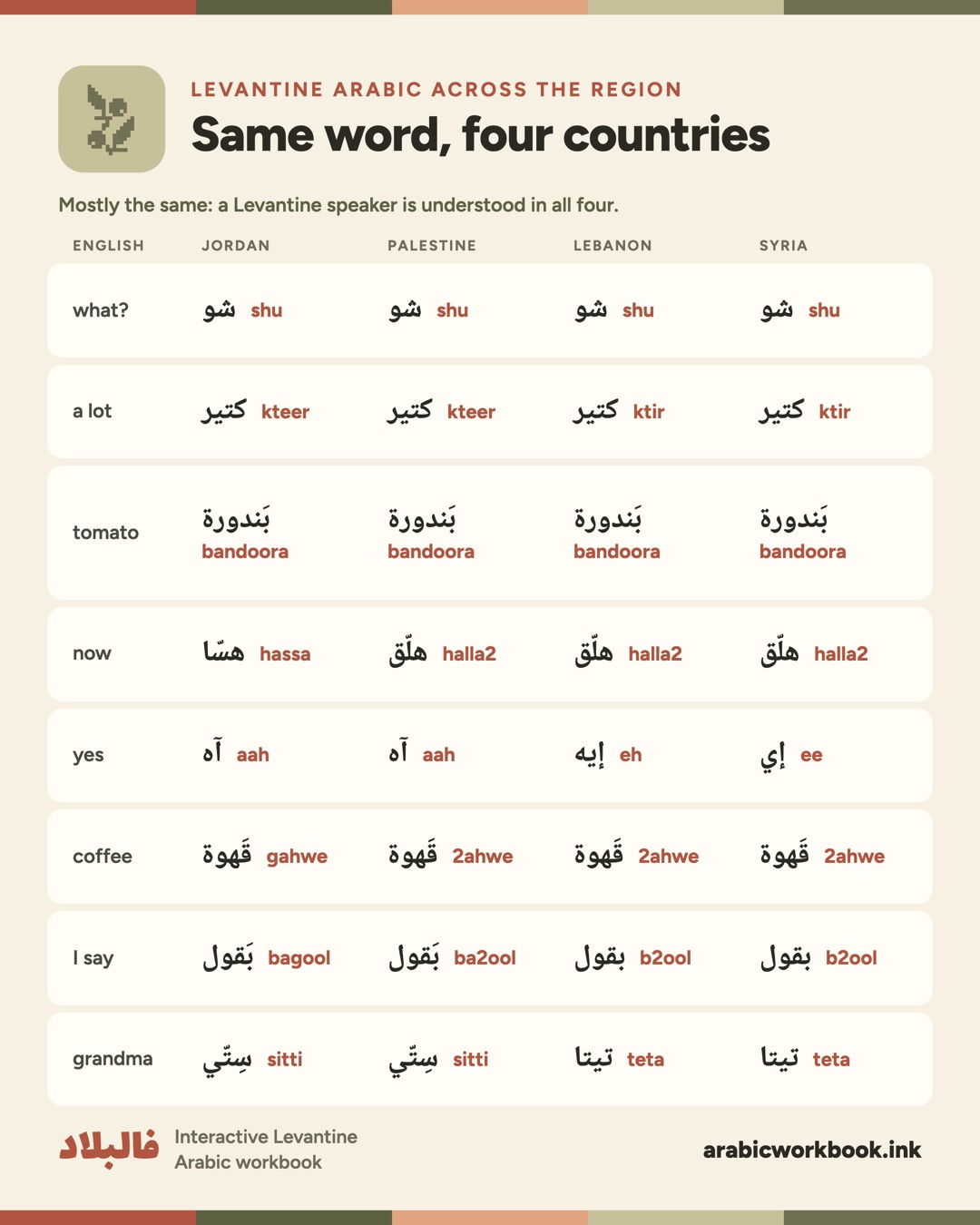
Most everyday words are shared. The differences are small and easy to pick up once you know one variety well. Here are a few you will notice.
| English | Jordanian–Palestinian | Lebanese | Syrian |
|---|---|---|---|
| what? | شو (shu) | شو (shu) | شو (shu) |
| how are you? (to a man) | كيفك؟ (keifak) | كيفك؟ (keefak) | كيفك؟ (keefak) |
| like this | هيك (heik) | هيك (heik) | هيك (heik) |
| now | هسّا (hassa) or هلّق (halla2) | هلّق (halla2) | هلّق (halla2) |
| yes | آه (aah) | إيه (eh) | إي (ee) |
| not | مش (mish) | مش (mish) | مو (mu) or مش (mish) |
| what are you doing? | شو بتعمل؟ (shu bti3mal) | شو عم تعمل؟ (shu 3am ti3mal) | شو عم تعمل؟ (shu 3am ta3mel) |
Pronunciation varies more than vocabulary. The letter ق is usually a glottal stop in the cities (قهوة, coffee, sounds like '2ahwe'), while many Jordanians and people in villages say it as a g ('gahwe'). Both are normal.
First phrases, with audio
These come straight from Unit 1 and Unit 5 of the workbook. Press ▶ to hear each one read by a native Levantine voice. There are many more in the Levantine Arabic phrases guide.
- كيف حالَك؟keif 7aalak?How are you? (to a man)
- كيف حالِك؟keif 7aalik?How are you? (to a woman)
- تمام شكرًاtamaam, shukranFine, thanks
- شو اسمَك؟shu ismak?What's your name? (to a man)
- من وين إنتِ؟min wein inti?Where are you from? (to a woman)
- صباح النورsaba7 in-noorGood morning (the reply)
- مسا الخيرmasa il-kheirGood evening
- كم الحساب؟kam il-7isaab?How much is the bill?
The grammar in five minutes
Spoken Levantine grammar is lighter than MSA: no case endings, fewer verb forms, and one little prefix does most of the work in the present tense. Each line below links to a full page with tables, audio and a quiz.
| Topic | Example | Meaning |
|---|---|---|
| Present tense: بـ + verb | بَدرُس (badrus) | I study / I'm studying |
| Future: رح + verb | رح أدرُس (ra7 adrus) | I'm going to study |
| Past tense: verb + ending | دَرَسِت (darasit) | I studied |
| Commands | روح! (roo7!) | Go! |
| Having: عِند + ending | عِندي (3indi) | I have |
| Possessive endings | بيتي (beiti) | my house |
| Negation: ما or مش | ما بعرف (ma ba3rif) | I don't know |
How to learn it
Learn the Arabic script and Arabizi side by side. Arabizi (Arabic written with Latin letters and numbers, see what is Arabizi) gets you typing on day one; the script lets you tell similar sounds apart and read signs and menus.
Start with greetings and the present tense, because you can say a lot with بـ + a verb. Then add رح for the future and the past tense. Listen as much as you can: Levantine series, podcasts and YouTube lessons, including Dania Shaikha's own Filblad videos, which are built into the workbook.
Speak early, even badly. A teacher, a friend or a family member is ideal. Between conversations, Sahara Studio lets you practise speaking Levantine out loud with an AI conversation partner.
Tip: Pick one variety and stick with it for your first months. Mixing Lebanese and Jordanian words is not a problem for being understood, but one consistent model makes the patterns easier to learn.
Check yourself
- How do you say 'How are you?' to a woman?
Show answer
كيف حالِك؟ · keif 7aalik?
- What does شو mean?
Show answer
شو · shu: what
- How do you say 'I have'?
Show answer
عِندي · 3indi
- Which little word makes the future: رح or بـ?
Show answer
رح · ra7
Questions people ask
Is Levantine Arabic the same as Arabic?
It is one of the main spoken varieties of Arabic. Arabic has one shared written standard (MSA) and many spoken dialects; Levantine is the spoken Arabic of Jordan, Palestine, Lebanon and Syria.
Is Levantine Arabic hard to learn?
Less than people expect. The script and a few sounds take practice, but the grammar is simpler than MSA, and you can start holding short conversations after a few weeks of regular practice.
Is Levantine Arabic worth learning?
Yes, if you want to talk to people from the Levant or watch its TV and films. It is widely understood across the Arab world, and it is what you will hear in Amman, Jerusalem, Beirut and Damascus.
How long does it take to learn Levantine Arabic?
It depends on how much you practise. With a little study every day, most beginners can introduce themselves, order food and ask directions within a few months. Fluency takes years, as with any language.
How do you say 'hi' in Levantine Arabic?
مرحبا (mar7aba) is the everyday hello. You will also hear أهلا (ahlan), and the reply أهلا فيك (ahlan feek).
Should I learn Levantine or MSA first?
If your goal is speaking, start with Levantine. If you need to read news or formal texts, you will want MSA too. See Levantine vs MSA.