Long vowels and short vowels
Arabic has three long vowels, written with full letters: ا (aa), و (oo) and ي (ee). You'll always see these, because they're part of the spelling.
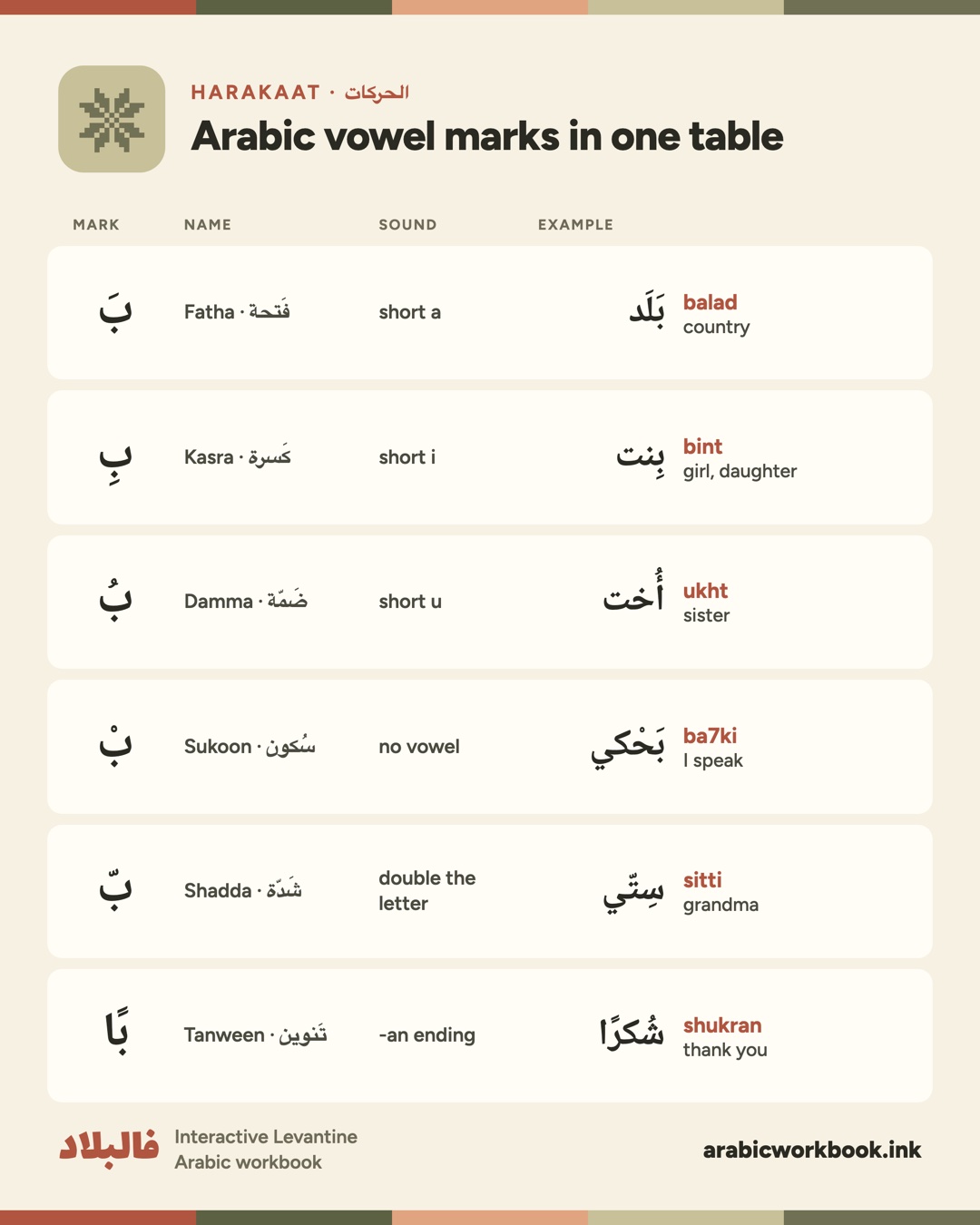
It also has three short vowels: a, i and u. These aren't letters. They're little marks called harakaat (حركات, "movements"), and adding them to a text is called tashkeel (تشكيل). The table below shows all of them on the letter ب (b).
| Mark | Name | Sound | Example |
|---|---|---|---|
| بَ | fatha · فتحة | short a, a small line above | بَلَد (balad), country |
| بِ | kasra · كسرة | short i, a small line below | بِنت (bint), girl |
| بُ | damma · ضمّة | short u, a small و above | أُخت (ukht), sister |
| بْ | sukoon · سكون | no vowel, a small circle | بَحْكي (ba7ki), I speak |
| بّ | shadda · شدّة | double the letter, a small w | سِتّي (sitti), grandma |
| بًا | tanween · تنوين | an -an ending, two lines | شُكرًا (shukran), thank you |
Fatha, kasra and damma
These are the three short vowels. Fatha is a short "a" as in "cat", kasra is a short "i" as in "sit" and damma is a short "u" as in "put". Each one sits on the letter it comes after: in بَلَد, the fathas tell you it's "balad", not "bld".
- بَلَدbaladcountry
- بِنتbintgirl, daughter
- عَربي3arabiArabic
- كِتابktaabbook
Tip: In spoken Levantine, a short vowel at the start of a word often disappears. The MSA كِتاب (kitaab) is usually said ktaab in Amman and Jerusalem.
Sukoon: no vowel at all
The sukoon is a small circle that means "stop: no vowel here". In بَحْكي (ba7ki, I speak), the sukoon on ح tells you to go straight from the 7 to the k. Without it you might guess "ba7aki".
- بَحكيba7kiI speak
- مِشmishnot
- ساكِنsaakinliving (somewhere), m.
Shadda: double the letter
The shadda looks like a small w and means the letter is said twice, or held for longer. سِتّي is "sit-ti", not "siti". It matters: shadda can change one word into another, so it's worth listening for.
- سِتّيsittigrandma
- تشَرَّفناtsharrafnanice to meet you
Tanween: the -an ending
Tanween doubles a vowel mark and adds an "n" sound. In MSA it marks grammar on lots of words, but in spoken Levantine it mostly survives in fixed words you learn as they are: شُكرًا (shukran), عَفوًا (3afwan), أهلًا (ahlan). That alif at the end is silent apart from the "an".
- شُكرًاshukranthank you
- عَفوًا3afwanyou're welcome
- أهلًاahlanhi, welcome
Why most Arabic leaves the vowels out
Open a newspaper, a menu or a WhatsApp chat and you'll see almost no harakaat. Native readers know the words, so the consonants and long vowels are enough. You'll see full vowel marks mainly in the Quran, children's books, poetry and books for learners.
That's why learners usually start with harakaat and then wean themselves off them. Spoken Levantine has no official spelling, so in dialect writing the marks are a guide to pronunciation rather than a strict rule. Two books may vowel the same word slightly differently.
How to practise reading without them
Learn each new word with its harakaat and its sound, then read it again without the marks. In the Filblad workbook there's a harakaat switch on every page, so you can do exactly that with the same text. Arabizi helps too: it shows you the vowels in Latin letters while your Arabic reading catches up.
Check yourself
- Which mark means "no vowel"?
Show answer
سُكون · sukoon
- Which mark doubles a letter?
Show answer
شَدّة · shadda
- How do you read بِنت?
Show answer
بِنت · bint
- Which vowel is the small line above the letter?
Show answer
فَتحة · fatha
Questions people ask
What are harakat in Arabic?
Harakaat (حركات) are the small marks written above or below Arabic letters to show the short vowels a, i and u, plus sukoon (no vowel), shadda (a doubled letter) and tanween (an -an, -in or -un ending).
What is tashkeel?
Tashkeel (تشكيل) means adding the harakaat to a text. A fully vowelled text is called mushakkal.
How many vowels does Arabic have?
Three short vowels (a, i, u), written as harakaat, and three long vowels (aa, ee, oo), written with the letters ا, ي and و.
Do Arabs write the vowel marks?
Mostly not. Everyday writing leaves them out. You'll see them in the Quran, children's books, poetry and material for learners.


